What is this?

Hi! My name is Ulrik, and this is my student blog. My posts will be based on tasks and subjects given to the class by my English teacher Ann. I am currently in my third year at Sandvika High School, Norway.

Sunday, January 18, 2015

London tour

This week, the English classes went on a school trip to London. Staying at the St. Giles Hotel, Monday-Friday, it became a great trip, packed with museum visits (and of course pubs). Among others, we went to Tate- modern, British museum, Churchill War Rooms, and Warner Brothers studios (the Harry Potter set).

Tate Modern

Myself, looking quite philosophical, at Tate Modern 
Tate Modern is Britains national modern art gallery, and the class went there the first day. With close to 4,9 million visitors each year, it's quite popular. The gallery is packed with modern artwork, and the exhibitions are called; 
  • 'History/Memory/Society'
  • 'Nude/Action/Body'
  • 'Landscape/Matter/Environment'
  • 'Still Life/Object/Real Life'
I am not that found of modern art, but there were some cool pictures, sculptures and whatnot. I really liked the exhibition showing Russian revolutionary posters. However, not really my thing (we ended up taking a cup of coffee).

The BBC

Inside the BBC News Broadcast Room
One thing I really enjoyed was the BBC. Since some of us was part of the team working on Connected Learners, Ann got us a guided tour in the all new BBC building. Finished in 2013, the building (where over 6000 people work!) is extremely modern, and looked like a great workplace. I was staggered by the, well, positive vibes inside the building; everyone seemed extremely satisfied with their job. 

With coffee (or tee for those wanting to be a bit more British) in our hands, we was guided by a journalist and the head of BBC Technology, who got us inside the broadcast room (where they do editing and stuff for the BBC news, which of course happens live); it was simply awesome. On the top floor we got to see BBC Radio One, which was just as great. If there is one place I, right now, would have worked- this place definitely tops the list. 

The Rosetta Stone

British Museum

After a late nigh, and a groggy morning, me and my friends rushed to British Museum; a museum packed with artefacts brought in from those places once conquered by Britain. We had quite many hours there, so I teamed up with a friend, and managed look through a large part of the museum. Of course, one of my favourite places was the Egyptian section with mummies and stuff, and the infamous Rosetta Stone. What's so special with this stone? It was the key to solving hieroglyphs. In  1799, Napoleons soldiers found this stone by coincidence- and it was three years later brought to British Museums (because the French lost to the Brits in that campaign). Not long after, french scientists cracked the puzzle (the French  managed to smuggle out documents and and copies).

The Rosetta stone is in fact a Ptolemaic decree, dating from 196 BC. It tells which taxes to be cut, and what statues to be built (short version). The decree was ordered in three languages, hieroglyphs, wynen (similar to greek), and demotic- all three found on that stone, thereby making it possible to translate the hieroglyphs.

In addition to the Rosetta Stone, we saw a cool clock-exhibition, and what is basically whole Greek temples transported back to Britain. And yes, both Egypt and Greece (among others) has demanded that some objects are to be returned, but Britain holds on tight to most of it. 

(source: British Museum)

Churchill War Rooms

During the war, the Germans bombed London to pieces during the Blitz. Westminster and the government was of course targeted, and Churchill had no other option than to move underground. Today, this bunker (which remained top secret for many years) is open to audience- and you are able see how the entire war cabinet worked and kept the war effort going. One fun fact (if you can say that), is that the bunker was never built to withstand powerful bombs, so a German direct hit would have destroyed everything- but that never happened, so well. 

We went there, and it was really cool- I have been there before, so I sort of rushed trough- but everything is kept they way it was. Maps, chairs, offices, meeting rooms etc.- it is all there. The war rooms also contains a Churchill museum, showing everything about his life and deeds. 

Me and Sindre driving Hagrids Motor bike. (pardon the filter,
it was taken for Instagram purposes)

Harry Potter 

The last day, we went to Warner Brothers Studios and their Harry Potter set. Being a 8 movie long franchises, the set got bigger and bigger- and they decided to make a museum out of it. The great hall, wand store, costumes, cars (like the tree stories London bus), the model used for filming Hogwarts- it is all there. I am not the biggest Harry Potter fan, but it was actually really awesome. I was amazed by all the objects created for these movies; paintings, houses, cars, books- the list goes on for ever. 

Different guided tours (walks), pubs, restaurants and cafès

Here lived Lawrence Of Arabia
In addition to museum visits, we had a couple of guided walks showing us around London and Westminster. The first walk I, to be honest, feel was a gossip anno 1880 tour. Really not much information, other than who had a romance with who and so on. We got see some interesting places though- such as a house Lenin had lived in. The other walk we had, around Westminster, I found much better. We learned a lot about the parliament, and the area around. To my joy, we went past the house of one of my favourite historical characters; Lawrence Of Arabia. I might do a post on him later!

The rest of the time in London, I mostly teamed up with two friends of my (Sindre and Anne), and tested out cafès, went on sighting, ate good food (Chinese in Chinatown for example), and tasted the local beer. Overall, it was a really great trip!

Sindre, Anne and me. Tnx London!
(sorry for shitty front camera)


Thursday, January 8, 2015

5 reasons for Obama to be satisfied

The last years has not been easy ones for president Obama, which was shown in the midterm elections. However, despite poor election results, he has achieved lots of goals he can be quite satisfied with:

Unemployment rate has gone down

People working in the states goes up month by month, and the oil prices are kept low. Mitt Romney promised to achieve an unemployment rate below 6%- Obama has achieved 5,8%.

Gas prices are low

To most peoples excitement, gas prices are now bellow 4,5 Norwegian kroner. Prices has gone down with over a dollar pr gallon the last year.

Relationship with Cuba

After fifty years of boycotts, and a hard line in diplomacy (non existing), Obama surprised everyone by handshaking Castro at Nelson Mandela's funeral. In all secrecy, the US government has negotiated with the Cuban government, and announced this winter that their relationship will be normalized. Polls show that the US population is more than happy with this, so Obama has really accomplished something!

Immigration policy

Obama has made sure over 4,2 million immigrants has received protection, and will not be thrown out.  Later polls show that people are happy with this (especially Spanish speaking), and most people want the congress to keep working in this direction, instead of trying to block Obama. 

Popular wars

Obama has pulled out troops from Afghanistan and Iraq, both wars with little support back home. However, his latest campaign against ISIS receives support- possible because he is not using large amount of ground forces. Obama has stated that he is skeptical when it comes to involving ground forces, due to poor results from previous occupations.   


Thursday, November 20, 2014

9/11 attacks

9/11 2001, the worst terror attack ever seen hit American soil. Two Boeing plains hit the twin towers, another hit the Pentagon; one went down on a cornfield, probably headed for the president. I thing everyone has seen those clips; the towers collapsing, people jumping; almost three thousand people were killed that day.

Today we watched "9/11", a documentary never ment to be, made by two french brothers; Jules and Gedeon Naudet. In 2001, they went to New York wanting to make film about being a probationary firefighter, Tony Benetatos. However, one day, out filming the firemen working on a gas leak, they hear a roar- the camera is pointed towards the sound, by reflex.

What was a normal innocent documentary-film job about a young firefighter, had now turned into filming history. The roar was jumbo jet, hitting the first tower. First on the scene, they were able to film inside the lobby of tower one, filming how firefighters started the demanding walk up over sixty floors; most of them would never come out alive. As the documentary is filmed in the lobby, showing how the chiefs are trying to organize the rescue work, you can hear screams, and bump sounds- people jumping.

The documentary is really showing what happened, from the inside. Few bodies are shown on camera, but there is no need for it either. The look on the firefighters eyes, the running when the tower collapses, people walking like ghosts trying to find their loved ones- the dust. The film is horrible, gruesome in it's way, but still so magnificently made.

Below is a clip from the documentary, showing the collapse from the inside.


Edublogs awards

My nominees for the Edublogs awards 


Best librarian blog, for being an awesome school librarian with an  awesome blog: Metaingrid.blogspot.com

Best student blog, for having a really good and informative blog: http://relatedsignals.com/

Best teacher blog, for using it active in class, posting great tasks and really making a difference: http://annmichaelsen.com/

Saturday, October 18, 2014

"If not me, who? If not now, when?"

Late September, Emma Watson held a speech at the UN. She addressed the importance of feminism, and launched a new campaign, called "He For She." The goal of the campaign is to mobilize men and boys, and make them the advocates for equal rights between the sexes. She started the speech by telling how she became a feminist, and said that:  "I decided I was a feminist and this seemed uncomplicated to me. But my recent research has shown me that feminism has become an unpopular word. Apparently I am among the ranks of women whose expressions are seen as too strong, too aggressive, isolating, anti-men and, unattractive."

In her speech, she made it clear how feminism is not a fight just for women, but also a fight for men; equal rights will benefit everyone; socially, politically and economical.

Watson's speech was, I think, a punch in the stomach to so many people, both men and women. Because, Watson has right;"feminism" has become an unpopular word. Very few of my friends, even though they say they want equal rights, would call themselves feminists. What Watson did with her speech, was to remind the world that feminism is not about women gaining power over men, it is simply about equal rights, that will benefit everyone. ¨

I have always regarded myself as a feminist, because I find it absurd that men earn more in salary for the same work as women. It's really quite simple. Unfairness is wrong, and the only way to remove this inequality is to fight for it, and never forget how much those before us had to fight, just to to get where we are today.

Emma Watson's campaign is important, because it is about remembering that feminism isn't a bad word, it is a word that should be won back.


http://www.heforshe.org/

Thursday, September 18, 2014

The Cameron ministry

On the 11th of may 2010 prime minister Gordon Brown and his Labour government resigned, giving the Downing street nr. 10 keys to  the new Conservative PM David Cameron.

With 36 percent of the votes, Cameron did not form his government alone. Being the first since Churchill, he formed a coalition government; he did so with the 23 percent Liberal Democrats.

Foreign policy


The Cameron ministry has, as most conservatives governments, a pro-NATO attitude, and has taken part in all NATO operation during the four years they have been in office. Cameron has stated that they believe in foreign intervention in order to spread "democracy and freedom", and that the terror-threat must be defeated by power.

The conservation wanted to intervene in Syria, but the Liberal Democrats voted against it in parliament, a major defeat for Cameron; one of the problems of a coalition. After the defeat Cameron stated that "I strongly believe in the need for a tough response to the use of chemical weapons but I also believe in respecting the will of this House of Commons ... It is clear to me that the British Parliament, reflecting the views of the British people, does not want to see British military action. I get that and the Government will act accordingly."

The ministry is against a full EU-membership, but Cameron believes some of the policies (fishing, military) are good for the UK. Overall they have a conservative attitude on foreign policies, with NATO being an exeption.

Economomy and climate

Some of the Cameron administration’s most important economic goals are reduction of employment and wealth tax. The administration views this as something important because they think this will boost English companies’ ability to compete in the international market. The administration does also wish to increase tax on flying for people who uses air transport a lot as well as remove tax for people who don’t use air transport that often, the administration wish to do this to make people fly less and in that way decrease the total amount of CO2 emission in the UK.

A economy policy that the Cameron ministry focuses on is enviroment. Cameron has descibed himself as "passionate about our environment" and believe that it is our "social responsibility to the next generation". Some of the reforms Cameron would like to introduce is a fair fuel stabilizer which will keep the oil prices stable. As the price of oil goes up, the taxes will decrease, and if the price of oil goes down, the taxes will also increase. Another policy is the taxation cut. The ministry promised to reduce tax on alcohol, corporations and small businesses, as well as increasing the inheritance tax exemption.

Thursday, September 4, 2014

6th June 1944; D-Day

This year is a year with many anniversaries; 100 years since the Great War, 25 years since fall of the Berlin wall, and 70 years since the Allied landings in Normandy, D-Day.

The Invasion of Normandy


In June, 1944, Nazi Germany was crumbling. For five years they had fought against nation after nation, laying most of Europe under occupation. Against them stood the Allied forces; mainly the US, UK, Canada, Australia and exiled troops from the occupied nations- such as Free France.

For several months, the Allied commanders had been planning the biggest military operation in history; the invasion and liberation of Europe, beginning with France. Codenamed "Operation Overlord", the invasion was to take place in Normandy; landings on the beaches and from the air. On a single day, 160.000 allied soldiers were to be put ashore, making way for over one million allied soldiers the following days. The goal of the first day? secure the beaches, crossroads and small towns near the coast- creating what is known as a spearhead. Name of the day? Operation Neptune, Delivery-day.

The operation was postponed several times due to bad weather, but soon the date was set; 6th of June. For a year, allied troops had been training in England, and the scale of the whole thing was meant to surprise the german forces.

The germans was of course expecting an invasion, but exactly how big and where was unclear. With hard fighting both on the Italian, African and Eastern front, the amount of german forces placed in the West was modest. The fortifications along the beaches was however heavy, and "Festung Europa" would not be easy to invade.

American soldiers, first wave, landing at Omaha.
Part of "magnificent eleven",
taken by Robert Capa on the beach.
Notice the falling soldiers.
On the night to the 6th of June, the allied forces crossed the channel. The same night, a number of airborne troops was dropped over inland Normandy
to destroy long-range artillery zeroed in on the beaches. In the morning, the german soldiers placed at the beaches codenamed "Utah", "Omaha", "Gold", "Juno" and "Sword" sounded the alarm, and prepared their positions. In the horizon, as a german soldier told in an interview; "there were more ships than we had men".

At 0630, the landings took place, and especially at Omaha the US-troop met severe resistance. With heavy incoming machine-gun fire, sharpshooters and small-artillery, Omaha became a living hell. In few hours, 3000 american soldiers lost their lives before before they managed to secure the beach. On other beaches the fighting was easier, but still with a high casualty rate. Overall there was at least 10.000 allied casualties on the first day; and the goals of the first day was not accomplished before D-Day+3. German casualties on day one lies at ca 4000.

Remembering D-Day

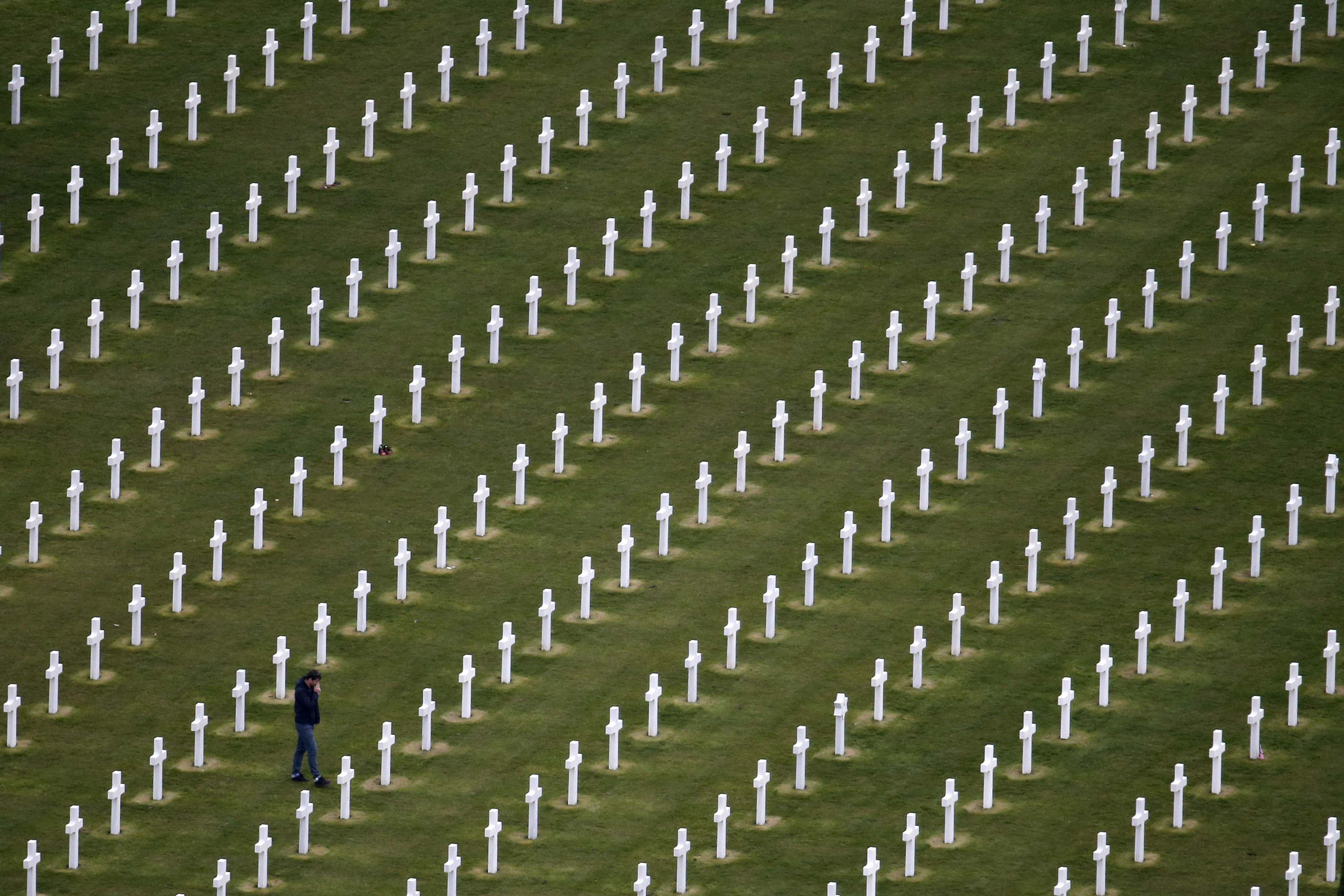
War cemetery for American soldiers in Normandy
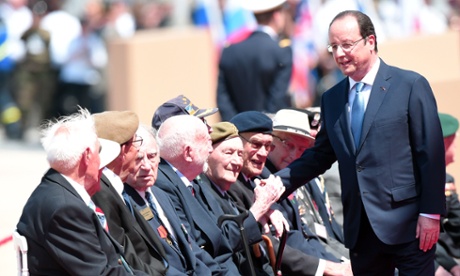
This year, being 70 years since the invasion, is an important year for many people; especially those who was there. Many veterans are still alive, and this is probably the last anniversary with so many attendants. A huge ceremony took place on the 6th of june this summer, with state officials from all the nations involved.
French president Hollande speaking to veterans
during the ceremony

Robert Edlin fought on Omaha with the 2nd ranger battalion. This is an extract from his accounts in the book "The voices of D-day":

"...there were bodies from the I I6th floating everywhere. They were facedown in the water with packs still on their backs. They had inflated their life jackets. Fortunately, most of the Rangers did not inflate theirs or they also might have turned over and drowned.

I began to run with my rifle in front of me. I went directly across the beach to try to get to the seaway. In front of me was part of the II6th Infantry, pinned down and lying behind beach obstacles. They hadn't made it to the seaway. I kept screaming at them, 'You have to get up and go! You gotta get up and go!' But they didn't. They were worn out and defeated completely. There wasn't any time to help them.

I continued across the beach. There were mines and obstacles all up and down the beach. The air corps had missed it entirely. There were no shell holes in which to take cover. The mines had not been detonated. Absolutely nothing that had been planned for that part of the beach had worked. I knew that Vierville-sur-Mer was going to be a hellhole, and it was.

When I was about twenty yards from the seaway I was hit by what I assume was a sniper bullet. It shattered and broke my right leg. I thought, well, I've got a Purple Heart. I fell, and as I did, it was like a searing hot poker rammed into my leg. My rifle fell ten feet or so in front of me. I crawled forward to get to it, picked it up, and as I rose on my left leg, another burst of I think machine gun fire tore the muscles out of that leg, knocking me down again..."